Church Management Academy

Education for Church Managers

  • Home Page
  • Education & Resources
    • Blog
    • Book
    • Workshops
  • About Us
    • Michael Castrilli
You are here: Home / Blog

By Michael Castrilli

Church Capital Assets Planning

Yesterday, I discussed the importance of creating a church capital assets budget! As a refresher, capital assets are simply those items that the church owns that have value extending beyond one year. Can you think of some examples?

Yes, I am sure you guessed – the church building, the rectory, or other assets like major equipment – for example, a boiler, the church organ, or computers and technology.

Interestingly, even though these assets are critical to accomplishing the mission of the parish, many parishes do not have a capital budget. This may be due to a number of factors, but the process of creating a capital budget does not have to be overly difficult.

If a church building is unusable due to maintenance, issues or the high cost operate the facility, how does the parish accomplish the critical mission? Capital budgets can be helpful in this regard.

Today, let’s walk through the various categories and questions that can help you put this budget together.

Capital improvements – Do you have any significant projects planned for new buildings, additions, major refurbishes or upgrades?

Asset purchases – Do you anticipate any purchases of new equipment like computers, software (e.g. financial management system) or other assets that will be available beyond one year?

Equipment repair – Do you have equipment that might require repair in the upcoming years? Is money available for unexpected equipment breakdowns?

Facility upgrades – Are there any updates planned or necessary? Examples might include painting, carpeting, or retrofitting classrooms for new LCD screens.

Deferred maintenance – Have resource been allocated for the replacement of assets before they fail? This category also includes scheduled or routine maintenance (e.g. the annual boiler inspection) to ensure that assets last for their expected useful life.

Don’t forget to consider any new planned investments on the horizon and ensure that you build into the budget the expected useful life of the assets. As you consider the categories above, create a three to five year (or more) budget. Remember, it does not have to be perfect! By undertaking this review and understanding your critical infrastructure needs, you may be surprised by the insights you gain.

Check out some of the most popular tips so far of the Church Finance 30/30 Series!

  • Budgets are about freedom, not constraint
  • Create a cash flow budget
  • Collaboration is the glue of insightful leadership, shared-accountability, and results
  • The budget is a reflection of your pastoral priorities
  • Prioritize time — calculate the budget category impact percentage

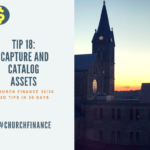
Tip 18, capture and catalog assets and a picture of sunrise at St. Meinrad Archabbey in Louisville, Kentucky.
Sunrise at St. Meinrad Archabbey

Filed Under: Church Budget and Finance Tagged With: Church Capital Assets, Church Finance Tips

By Michael Castrilli

Church Budget Freedom

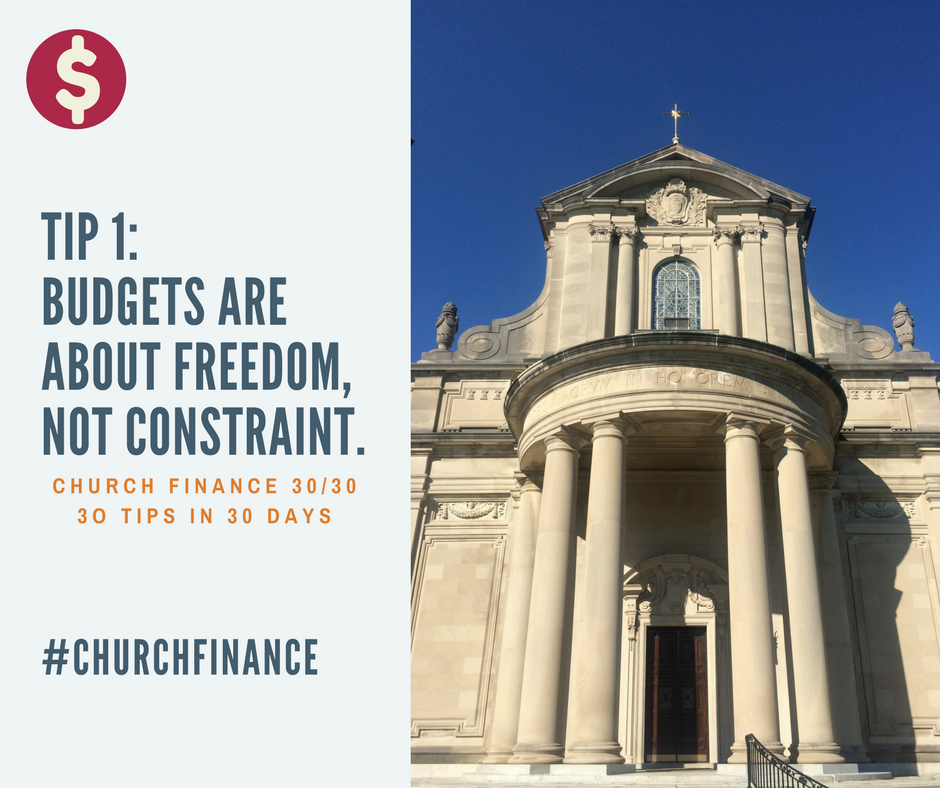
Church finance postcard that shows a church and the church finance tip, budgets are about freedom not constraint

Church budget freedom may sound like an oxymoron, but it is not! Read on.

Money discussions are not always the most positive of conversations. When talking about finances, have you ever heard a married couple talking about a budget and say with enthusiasm, “Guess what, we have $100 more dollars in our budget this month spend!!! YAY.”

More often is the case, what happens? There is a fight.

  • “We have spent too much this month!”
  • “How could you put that on the credit card?”
  • “We are never going to catch up.”
  • “We can’t afford this!”
  • “Even though we budgeted $100, we can’t really spend it!”

Although this may sound counterintuitive, budgets are actually about offering people and organizations freedom to make financial decisions. Yes, budgeting is about making limits clear, but it is also about enabling the church to allocate resources to the highest priority areas and accomplish pastoral goals.

Let’s use the example of expenses. Budget freedom comes from knowing how much you have available to spend on a specific category (liturgical supplies, CCD books, vacation bible school), and then knowing that the money is, in fact, available to be spent.

Here is the key point – When a budget is created with the truth in mind – meaning being honest with how much you estimate that you really, truly have available to spend and being realistic about how much you really, truly expect to receive – the budget becomes a tool and not a penalty stick.

Why put together a budget if you really don’t want to spend the amount you have budgeted?

Some then argue, “BUT, what about saving money?” Great question!

If you want to save money, no need to always worry about it!  Instead of hoping that the money you have budgeted for a given category is not actually spent – budget a new expense line item called – Transfer to Savings. This way, you have specified an amount of money for each month, that you have budgeted AND where you can feel great about spending the full amount.

Budget development cannot be about wishful thinking or hopeless estimating – it must be about the truth.  Then, and only then, does the budget become a management tool, instead of a painful, anxiety-producing process and plan used to manage finances.

Free your mind and heart – change the conversation from constraint to freedom!

Read more about church budget freedom in our book: Parish Finance: Best Practices in Church Management.


Tip 1 is brought to you by the Church Finance 30/30 Series – Check back to the blog as I reveal my thirty favorite quick tips on the topics ministers struggle with most. We’ll discuss budgeting, financial decision-making, safeguarding assets, and facilities management.

Church finance postcard that shows a church and the church finance tip, budgets are about freedom not constraint

Filed Under: Church Budget and Finance Tagged With: Church Finance Tips

By Michael Castrilli

Which Church Financial Accounting Software Do I Choose?

St. Charles Borromeo Seminary

“What is the best church financial accounting software?” If I had a dollar for the number of times I have been asked this question in a webinar or workshop, I would be rich! It is a great question and one that I like to answer as objectively as possible.

When you search Google for the question, over 87 million results are returned!  Sorting through this maze of results can be overwhelming, to say the least.

For the record, I receive no advertising dollars for this recommendation, but there is one resource where I always send people – Church Leaders – Church Management Software Guide.

What I love about this site is that it allows you to “click” all of the features you are looking for in church financial accounting software.  As you “click” through options, the list of available software options narrows based on the features you seek.

For example, are you interested in software that has Membership features? When you click Membership, the section opens a series of boxes that you can checkmark like, “tracks special events in the life of members” or “tracks attendance.” Maybe you are looking for website integration and you want to provide online giving, you can also select this option under Website Features. Ministry Tech by Church Leaders is also open about their disclaimer for those software companies that advertise on their site.

It’s a great resource! Check it out and let me know what you think!

https://churchleaders.com/church-management-software

St. Charles Borromeo Seminary

Filed Under: Church Budget and Finance, Church Financial Accounting Software Tagged With: Which Church Financial Accounting Software Should I Choose?

By Michael Castrilli

Using The Line Graph to Report Church Financial Information

Church financial visuals displaying the line graph

We know that choosing the best visual is not a one-size fit all approach for church financial reports, so when do we choose the line graph?  We’ve already discussed the pie chart, the bar chart, and now it is time to talk about the advantages and cautions of the line graph!

The Line Graph

Line graphs connect individual data points and then connect the points with a line. These graphs are primarily used to display trends in data.

Advantages

  • Line graphs can quickly show data ranges, minimums, gaps, clusters or outliers.
  • Similar to the bar/column chart, the line graph can help readers visualize trends, bumpiness or patterns in data.The graph is useful when data contains evenly spaced values such as months, quarters, or fiscal years.
  • The graph is useful when data contains evenly spaced values such as months, quarters, or fiscal years.

Cautions

  • The line graph is less appealing to the reader than other visuals that can be used (i.e. bar/column charts) to display similar data.
  • Be sure to create a “Key” that distinguishes the various lines in the graph.
  • Ensure that the horizontal and vertical axes scales are right-sized given the range of data that is presented.

Next week, we dive into the Data Table!

Interested in learning more about visuals for church financial reporting? Read our previous  posts:

  • Communicate Church Financials with Impact and Ease
  • All Pictures Are Not Worth 1,000 Words for Church Financial Reports
  • Church Visuals – Bar’s Aren’t Only for Drinking – The Bar Chart

Filed Under: Church Budget and Finance

By Michael Castrilli

Collaboration Yields Results

Church finance tip 4 is collaboration is the glue of insightful leadership, accountability, and results. Picture of the tapestry at the Los Angeles Catholic Cathedral in California.

There is powerful research that concludes that collaboration in fact yields results. James Surowiecki epic work, Wisdom of the Crowds, was groundbreaking in summarizing research that strongly supported the principle that “No one of us is smarter than all of us.”

One example in the book, that I found particularly useful in helping me understand the benefits achieved through collaboration, comes from the television game show, Who Wants to Be a Millionaire, hosted by Regis Philbin.

During the show, contestants worked through trivia questions in their attempt to win $1,000,000. As a fun twist, if the contestant faced difficulty with answering a question, they had three options available. They were only allowed to use each option once, throughout their time on the show. The options included:

  1. 50-50 – The computer eliminates two of the incorrect answers, giving the contestant a fifty-fifty chance at the right response
  2. Phone-a-Friend – Prior to the show, contestants singled out someone they could call for help who they considered one of the smartest people they knew
  3. Poll the Audience – The studio audience would cast votes by computer

From the results* of the show, Surowiecki writes:

“Everything we think we know about intelligence suggests that the smart individual would offer the most help. And, in fact, the ‘experts’ did okay, offering the right answer – under pressure – almost 65% of the time. But they paled in comparison to the audiences. Those random crowds of people with nothing better to do on a weekday afternoon and sit in a TV studio picked the right answer 91% of the time…” (Wisdom of the Crowds, 2004, Page 4)

Tip 4: Collaboration is the glue of insightful leadership, shared-accountability, and results

What does this have to do with church budgeting? The show is just the fun example of the benfits of collaboration. But, collaborative budget processes and operational management does prove time and time again to yield results.

A budget that is developed by one or two people does nothing to build a broader spirit of shared accountability across the church. Many leaders feel they may lose control when they bring others into the budget process. However, management research proves that involvement by a team in financial matters, specifically people responsible for the finances of a particular area, will more likely lead to better results.

Why?

If someone is involved in the budget process, and they feel as if they have had the opportunity to offer feedback and input, they’re more likely to “own” and “buy-in” to what has been created. Without participation in the process, resentment builds and can ultimately lead staff to consciously, or unconsciously, undermine what has been created.

Collaboration paired with open communication is where the budget will help church managers achieve the greatest potential of their organization.

Read more tips from Church Finance 30/30 – 30 Tips in 30 Days!

*Note: Surowiecki admits that this experiment would not stand scientific scrutiny. However, other examples in the book, would, in fact, support such an inquiry.

Filed Under: Church Budget and Finance Tagged With: Church Finance Tips

  • « Previous Page
  • 1
  • 2
  • 3
  • 4
  • 5
  • …
  • 10
  • Next Page »

Sign-Up for Academy News and Resources

We promise not to spam you!
* indicates required


Copyright © 2026 Church Management Academy