Church Management Academy

Education for Church Managers

  • Home Page
  • Education & Resources
    • Blog
    • Book
    • Workshops
  • About Us
    • Michael Castrilli
You are here: Home / Archives for Church Budget and Finance

By Michael Castrilli

Church Capital Assets Planning

Yesterday, I discussed the importance of creating a church capital assets budget! As a refresher, capital assets are simply those items that the church owns that have value extending beyond one year. Can you think of some examples?

Yes, I am sure you guessed – the church building, the rectory, or other assets like major equipment – for example, a boiler, the church organ, or computers and technology.

Interestingly, even though these assets are critical to accomplishing the mission of the parish, many parishes do not have a capital budget. This may be due to a number of factors, but the process of creating a capital budget does not have to be overly difficult.

If a church building is unusable due to maintenance, issues or the high cost operate the facility, how does the parish accomplish the critical mission? Capital budgets can be helpful in this regard.

Today, let’s walk through the various categories and questions that can help you put this budget together.

Capital improvements – Do you have any significant projects planned for new buildings, additions, major refurbishes or upgrades?

Asset purchases – Do you anticipate any purchases of new equipment like computers, software (e.g. financial management system) or other assets that will be available beyond one year?

Equipment repair – Do you have equipment that might require repair in the upcoming years? Is money available for unexpected equipment breakdowns?

Facility upgrades – Are there any updates planned or necessary? Examples might include painting, carpeting, or retrofitting classrooms for new LCD screens.

Deferred maintenance – Have resource been allocated for the replacement of assets before they fail? This category also includes scheduled or routine maintenance (e.g. the annual boiler inspection) to ensure that assets last for their expected useful life.

Don’t forget to consider any new planned investments on the horizon and ensure that you build into the budget the expected useful life of the assets. As you consider the categories above, create a three to five year (or more) budget. Remember, it does not have to be perfect! By undertaking this review and understanding your critical infrastructure needs, you may be surprised by the insights you gain.

Check out some of the most popular tips so far of the Church Finance 30/30 Series!

  • Budgets are about freedom, not constraint
  • Create a cash flow budget
  • Collaboration is the glue of insightful leadership, shared-accountability, and results
  • The budget is a reflection of your pastoral priorities
  • Prioritize time — calculate the budget category impact percentage

Tip 18, capture and catalog assets and a picture of sunrise at St. Meinrad Archabbey in Louisville, Kentucky.
Sunrise at St. Meinrad Archabbey

Filed Under: Church Budget and Finance Tagged With: Church Capital Assets, Church Finance Tips

By Michael Castrilli

The 3-R Approach to Address Financial Challenges

Tip 26: Address financial challenges with 3R, Reflect, Review, Refine and a picture of St. Peter's Basilica in Rome, Italy

Previously we have discussed how to construct a church financial narrative with impact and ease. However, we all know that writing about money is simple when finances are in great shape. Inevitably, church financial challenges occur and also need to be communicated.

Address Financial Challenges with 3-R

Picture of doors with the inscription "Holy doors of Mercy" showing that openness if required when it comes to addressing financial challenges
The Cathedral Basilica of Saints Peter and Paul., Philadelphia, PA

For example, from a decrease in collections, the parish drew a larger percentage of endowment funds than in previous years. Responding to financial challenges can feel overwhelming, but consider breaking the problem down using the 3-R Approach. The first step is to Reflect what has occurred. What is the actual data telling you about what happened? The second step is to Review reasons or circumstances and consider any changes that are necessary for the future. The third step is to Refine any policies and procedures to mitigate the likelihood that the problem will occur again.

When reporting a challenging situation, keep the narrative simple, straightforward, and offer answers to the relevant “W” questions.

  • What happened?
  • Who is/was involved?
  • When did it take place?
  • Why did it happen?

So, we have constructed the financial narrative, we have addressed any challenges, now what? Let’s choose the most compelling visuals to include in your financial reports. Next week we discuss choosing visuals to communication financial understanding!

Read More Church Finance 30/30 Tips

Filed Under: Church Budget and Finance

By Michael Castrilli

The Benefits of Church Budgeting

Image of Dove

My experience working with ministers is that for many, developing a church budget is a necessary, yet stressful and time-consuming exercise. People resist or even fear the topic because of seemingly complicating processes or past negative experiences. Even with personal finances, many people grow up learning that developing a budget is good practice but a constraining activity designed to prevent or control people from doing all of the things they want to do.

So, why spend the time working on the church budgeting process? Below are six benefits:

Church Budget Benefits

The budget is the plan and tool that will help you…

  1. Connect resources to parish priorities
  2. Create a plan to allocate money coming into the parish and expenses to be paid
  3. Ensure that plans stay on track
  4. Empower effective financial decisions
  5. Bring collaboration, communication, and buy-in
  6.  Strategize for the future

Filed Under: Church Budget and Finance

By Michael Castrilli

Collaboration Yields Results

Church finance tip 4 is collaboration is the glue of insightful leadership, accountability, and results. Picture of the tapestry at the Los Angeles Catholic Cathedral in California.

There is powerful research that concludes that collaboration in fact yields results. James Surowiecki epic work, Wisdom of the Crowds, was groundbreaking in summarizing research that strongly supported the principle that “No one of us is smarter than all of us.”

One example in the book, that I found particularly useful in helping me understand the benefits achieved through collaboration, comes from the television game show, Who Wants to Be a Millionaire, hosted by Regis Philbin.

During the show, contestants worked through trivia questions in their attempt to win $1,000,000. As a fun twist, if the contestant faced difficulty with answering a question, they had three options available. They were only allowed to use each option once, throughout their time on the show. The options included:

  1. 50-50 – The computer eliminates two of the incorrect answers, giving the contestant a fifty-fifty chance at the right response
  2. Phone-a-Friend – Prior to the show, contestants singled out someone they could call for help who they considered one of the smartest people they knew
  3. Poll the Audience – The studio audience would cast votes by computer

From the results* of the show, Surowiecki writes:

“Everything we think we know about intelligence suggests that the smart individual would offer the most help. And, in fact, the ‘experts’ did okay, offering the right answer – under pressure – almost 65% of the time. But they paled in comparison to the audiences. Those random crowds of people with nothing better to do on a weekday afternoon and sit in a TV studio picked the right answer 91% of the time…” (Wisdom of the Crowds, 2004, Page 4)

Tip 4: Collaboration is the glue of insightful leadership, shared-accountability, and results

What does this have to do with church budgeting? The show is just the fun example of the benfits of collaboration. But, collaborative budget processes and operational management does prove time and time again to yield results.

A budget that is developed by one or two people does nothing to build a broader spirit of shared accountability across the church. Many leaders feel they may lose control when they bring others into the budget process. However, management research proves that involvement by a team in financial matters, specifically people responsible for the finances of a particular area, will more likely lead to better results.

Why?

If someone is involved in the budget process, and they feel as if they have had the opportunity to offer feedback and input, they’re more likely to “own” and “buy-in” to what has been created. Without participation in the process, resentment builds and can ultimately lead staff to consciously, or unconsciously, undermine what has been created.

Collaboration paired with open communication is where the budget will help church managers achieve the greatest potential of their organization.

Read more tips from Church Finance 30/30 – 30 Tips in 30 Days!

*Note: Surowiecki admits that this experiment would not stand scientific scrutiny. However, other examples in the book, would, in fact, support such an inquiry.

Filed Under: Church Budget and Finance Tagged With: Church Finance Tips

By Michael Castrilli

Church Visuals – Bars Aren’t Only For Drinking – The Bar Chart

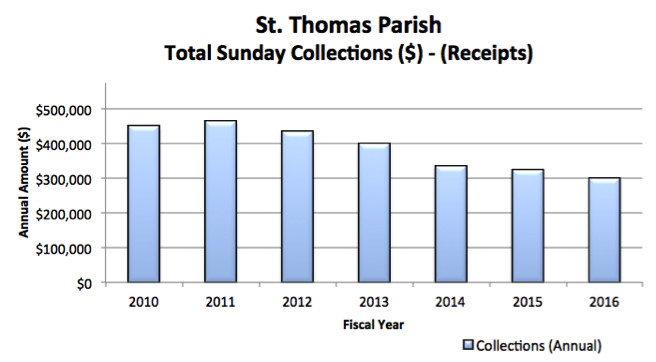
Church Financial visual that displays a bar chart

As churches balance the broad range of financial information that parishioners seek, they also struggle with what to report and how to communicate this information. As we continue our discussion on best practices for communicating church finances with impact and ease and choosing the best visuals, let’s turn the infamous bar chart!

The Bar Chart

One of the most common visuals in reports is a bar/column chart. Using bars or other shapes, the visual displays discrete data in separate columns. These charts can be used to show one data set, or compare two or more data sets by lining them up in the same graphic.

Bar Charts Advantages

  • The chart offers readers a simple way to visualize data highs and lows at a glance.
  • The bar chart can help readers visualize trends, bumpiness or patterns in data. Trends occur when information moves in a general direction, or data can look bumpy meaning that the information is erratically up and down. The graph can also show patterns where data moves in a repeating fashion.
  • The use of colors and shapes offer an easy to read and appealing visually.
  • Comparing bars one against the other can quickly show progress or differentiation.

Cautions

  • If using a variety of colors to display more than two categories of data, ensure that the data can be easily recognized. For example, a black and white report may not show the subtle differences between columns.
  • Label the horizontal (X) and vertical (Y) axes.
  • Be careful not to overwhelm readers with so much data that the chart looks messy and then becomes difficult to read.

Next up in the world of visuals, Line Graphs! Interested in reading more? Read last week’s post All Pictures are Not Worth 1,000 Words – The Pie Chart

Church Financial visual that displays a bar chart

Excerpt from my original article in the Villanova University Center for Church Management and Business Ethics Newsletter, “Communicate Church Financial Information with Impact and Ease” (Spring 2017).

Filed Under: Church Budget and Finance

  • 1
  • 2
  • 3
  • …
  • 9
  • Next Page »

Sign-Up for Academy News and Resources

We promise not to spam you!
* indicates required


Copyright © 2026 Church Management Academy