Church Management Academy

Education for Church Managers

  • Home Page
  • Education & Resources
    • Blog
    • Book
    • Workshops
  • About Us
    • Michael Castrilli
You are here: Home / Archives for Church Finance Tips

By Michael Castrilli

Collaboration Yields Results

Church finance tip 4 is collaboration is the glue of insightful leadership, accountability, and results. Picture of the tapestry at the Los Angeles Catholic Cathedral in California.

There is powerful research that concludes that collaboration in fact yields results. James Surowiecki epic work, Wisdom of the Crowds, was groundbreaking in summarizing research that strongly supported the principle that “No one of us is smarter than all of us.”

One example in the book, that I found particularly useful in helping me understand the benefits achieved through collaboration, comes from the television game show, Who Wants to Be a Millionaire, hosted by Regis Philbin.

During the show, contestants worked through trivia questions in their attempt to win $1,000,000. As a fun twist, if the contestant faced difficulty with answering a question, they had three options available. They were only allowed to use each option once, throughout their time on the show. The options included:

  1. 50-50 – The computer eliminates two of the incorrect answers, giving the contestant a fifty-fifty chance at the right response
  2. Phone-a-Friend – Prior to the show, contestants singled out someone they could call for help who they considered one of the smartest people they knew
  3. Poll the Audience – The studio audience would cast votes by computer

From the results* of the show, Surowiecki writes:

“Everything we think we know about intelligence suggests that the smart individual would offer the most help. And, in fact, the ‘experts’ did okay, offering the right answer – under pressure – almost 65% of the time. But they paled in comparison to the audiences. Those random crowds of people with nothing better to do on a weekday afternoon and sit in a TV studio picked the right answer 91% of the time…” (Wisdom of the Crowds, 2004, Page 4)

Tip 4: Collaboration is the glue of insightful leadership, shared-accountability, and results

What does this have to do with church budgeting? The show is just the fun example of the benfits of collaboration. But, collaborative budget processes and operational management does prove time and time again to yield results.

A budget that is developed by one or two people does nothing to build a broader spirit of shared accountability across the church. Many leaders feel they may lose control when they bring others into the budget process. However, management research proves that involvement by a team in financial matters, specifically people responsible for the finances of a particular area, will more likely lead to better results.

Why?

If someone is involved in the budget process, and they feel as if they have had the opportunity to offer feedback and input, they’re more likely to “own” and “buy-in” to what has been created. Without participation in the process, resentment builds and can ultimately lead staff to consciously, or unconsciously, undermine what has been created.

Collaboration paired with open communication is where the budget will help church managers achieve the greatest potential of their organization.

Read more tips from Church Finance 30/30 – 30 Tips in 30 Days!

*Note: Surowiecki admits that this experiment would not stand scientific scrutiny. However, other examples in the book, would, in fact, support such an inquiry.

Filed Under: Church Budget and Finance Tagged With: Church Finance Tips

By Michael Castrilli

Budgets guide people, but people control budgets

Rome on the seashore

Budgets are not developed to restrict you. Never forget, human beings are the ones that are managing the budget! You can’t take human insight, experience, and instinct out of financial management.

Remember a budget is not created to make you feel like you are trying to drag an anchor through the church pew.

Tip – Budgets guide people, but people control budgets

People often feel as if they are a servant to the budget, instead of the reverse. The budget is a plan, or a guide, to manage the money coming into the church (revenues) and the money going out (expenses).  As with any plan, at times, adjustments need to be made. Budgets are not meant to be perfect. By the very nature of a budget, we forecast revenue and expenses. A forecast is a prediction, and without humans to help navigate the budget, it merely becomes a nice looking, Excel spreadsheet!

What do you do about mistakes? Remember, you can always deploy the 3-R Approach to address financial challenges.

The key point – People are the critical link between a budget that works and a budget that fails.

Tip 2 is brought to you by the Church Finance 30/30 Series

Filed Under: Church Budget and Finance Tagged With: Church Finance Tips

By Michael Castrilli

Perfect Is The Enemy of Good

A picture of Sagrada Familia, Barcelona Spain

Yesterday, we discussed the four stages of the church budget process. As you implement the four stages, it is important to remember a guiding principle –  perfect is the enemy of good! Why wait to create a collaborative and transparent budget process until you believe every aspect is perfect? No need to wait, you can start by just taking the first step.

Establish a Process

The first year of any new process can be challenging, but once established, every part of the organization will be on the same page of what is expected. For example, if your budget begins on July 1, you may want to establish that budget guidance will be distributed each April and the draft budget will be proposed by Memorial Day. Developing a schedule of key budget process dates provides everyone more flexibility so those involved can effectively manage their time. Establish a process in year one with the knowledge that it may not be perfect and that you can refine it by year two.

Reflection Questions 

  • What are the key dates or milestones for the various phases of the budget process?
  • Have I informed others about what is expected of them by certain dates?

Provide Clear Guidance

Give clear guidance on your expectations for the process, the future, and what success looks like moving forward. If you are going to ask others for information, communicate your objectives and provide visibility in your thinking for the upcoming year.

Reflection Questions:

  • Am I clear in my direction and thinking surrounding priorities?
  • Do I need to simplify or improve how individuals submit calculations and estimates?
  • Do I need to develop additional guidance surrounding narrative descriptions?

Open Communication Lines and Seek Feedback

The budget process should be an opportunity for all voices to be heard. When you open the budget process for the upcoming year and set expectations, hold a town hall meeting where all parishioners are welcome. Listen to the voices of the people around you. Open up the priority setting process so you can gain broader involvement and commitment by the staff and your parishioners. Ask individuals to help brainstorm ideas. If not, then be clear as to the direction you are setting. When others feel involved, they will be more committed.

Reflection Questions:

  • Who are your stakeholders that need to be brought into this process?
  • What voices have been missing that will help you create a spirit of openness and transparency?

Read More Church Finance 30/30 – 30 Tips in 30 Days

Filed Under: Church Budget and Finance Tagged With: Church Finance Tips

By Michael Castrilli

Prioritize Your Time

Tip 7 Prioritize time - deploy the budget category impact percentage calculation

There is no doubt that church managers are busy people. As you develop a budget, focusing on the “right” areas of the budget means prioritizing your time so that you spend the greatest amount of effort on those areas that will provide the most significant benefits. A nice tool to deploy during this phase of the process is to calculate the Budget Category Impact Percentage (BCIP).

If time is money, the BCIP calculation is a simple formula that can assist you to quickly assess the relative size of a specific budget category as compared to the total receipt or spending for the overall Income or Expense category. If you calculate which categories have the greatest impact on the budget, you can spend the majority of your time focusing on those areas.

Let me use a simple example of revenue categories to show you what I mean:

St. Jane’s Church

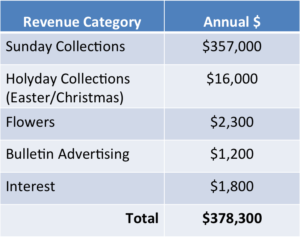
At the fictional parish of St. Jane’s, the church receives revenues from the following sources:

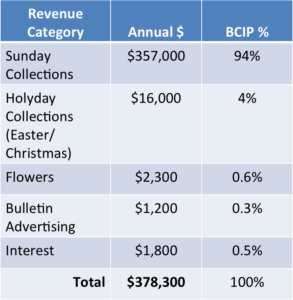
Next, calculate the BCIP by dividing each Revenue Category by Total Revenue.

  • Total Collections ($357,000) divided by Total Revenue ($378,300) = BCIP (94%)
  • Total Holyday Collections ($16,000) divided by Total Revenue ($378,300) = BCIP (4%)

Using a spreadsheet or other mode to make calculations, you can make the calculations for each category quickly by dragging the formula down the column. As you review the information, what are your observations?

Display of budget by category, total amount of the annual budget, and the budget category impact percentage

Like most churches, Sunday Collections drive the majority of the income for St. Jane’s. You can see that items like Flower Donations and Bulletin Advertising make up only a tiny proportion of the overall revenue.

“So, why does this matter?”

The problem is that many churches spend an inordinate amount of time on reviewing/estimating/analyzing categories that are not driving large portions of the budget. If you have two hours to spend on a budget analysis, focus on the largest drivers of revenues and expenses. By the way, the same process used above for revenues should also be used for expenses. Most likely, after you calculate the BCIP on expenses, you’ll find that salary and benefits make up a large proportion of expenses, and this makes sense because people are your most important resource! Take the analysis to the next step – what is the next expense category that is driving expenses? And the next?

Tip 7: Prioritize Time – Calculate a Budget Category Impact Percentage (BCIP)

Armed with this information, you can begin by reviewing those categories with the largest impact on the budget. I am not arguing that all budget categories are not important. But, with limited time, focus on the income or expense categories with the greatest impact on the budget.

Read More Church Finance 30/30 Tips

Portions of this text come from Michael J. Castrilli and Charles E. Zech, Parish Finance: Best Practices in Church Management (New York: Paulist Press, 2016) Chapter 5.

Filed Under: Church Budget and Finance Tagged With: Church Finance Tips

By Michael Castrilli

Church Priorities + Budget = Results

picture of the outside of St. Paul Catholic Church in Philadelphia Pennsylvania

Show me your budget and I can tell you how you spend your time, where you focus your resources, and what you believe are the greatest priorities for your church and programs.

Think about your personal spending. If you showed me your latest bank statement or credit card bills, I would be able to tell you how you spend your time and where you focus your personal resources. All I would have to do is take your income and expenses for the statement period and assign categories to the ones we see repeated.

For example, I may see expenses for great restaurants (dining), a gym membership (fitness), doctor visits or medications (medical), and ticket purchases for shows and concerts (entertainment).

On the incoming side, I may see a check deposit from your job (salary). If you provided two or three months of data, I would have a good idea about how you prioritize resources.

Tip 6:  The budget is a reflection of your pastoral priorities

The same can be said of your church priorities. What are the categories of income and spending that the parish receives and spends? Most likely, the largest income category for the church includes offertory collections while staff salary and benefits drive the majority of expenses. These categories make sense as priorities. Without collection income, the church would have virtually no resources to operate besides savings or any endowments. Salary and benefits also make sense because of the need for the most critical resource for any organization—people to accomplish the work.

This makes analyzing the next categories of spending very important. After salary and benefits, what is the next highest level of spending? And next? And next? This is when budget analysis can really help determine a way forward (More on this topic later in the week).

There is no doubt that church leaders are busy people, so the next step in the process is to take the data that has been collected and focus your time. Focusing on the “right” areas of the budget means prioritizing your time so that you spend the greatest amount of effort in those areas that will provide the most significant benefits. A nice tool to deploy during this phase of the process is to calculate the Budget Category Impact Percentage (BCIP). Tomorrow, we will discuss how to calculate the BCIP!

Read More Church Finance 30/30 Tips

Filed Under: Church Budget and Finance Tagged With: Church Finance Tips

  • « Previous Page
  • 1
  • 2
  • 3
  • 4
  • Next Page »

Sign-Up for Academy News and Resources

We promise not to spam you!
* indicates required


Copyright © 2026 Church Management Academy