Selecting a company or individual to do major work at the church can be overwhelming. From short and long-term impacts on money, time, and people, along with oversight responsibilities, resources are always limited (scarce). Investing in the right people, places, or things are critical for effective parish management.
This post describes a step-by-step process churches can use for evaluating and selecting a vendor, contractor, or service provider. Recognizing this can be a complex topic, the goal is to break the process down into manageable parts. After learning the method, you can right-size the concepts to fit the needs at your church.
Examples, where you might like to use a selection strategy, include large–scale projects like choosing an architecture firm to put blueprints together for a parish facility or deciding which builder to hire for repairing the church roof. This type of process can also be used for major purchases like choosing which church management software to buy.
To simplify the terminology, throughout this post, I’ll use the words “contractor/vendor” as an all-inclusive term to include any external product or service being purchased by the church. For example, this term encompasses service providers (e.g. architecture firm, lawn care company), builders/manufacturers (e.g. construction company), Jane/Joe self-employed business, and/or vendors (e.g. church management software company).
Challenges
One of the main reasons selecting a contractor/vendor can be so complex in the church environment is that at times, the lines between pastoral care and business interest get blurred. Let me use an example of a local church that is seeking to hire someone to replace the roof.
Church Roof Replacement: The parish administrator made a presentation to the parish council on the need to replace the church roof. The estimated cost for the current roof to be removed and a new roof to be replaced is in the $100,000 ballpark. After the presentation, a member of the Council approaches the administrator and says, “My company would be happy to do this work. I’ll even try to get you a discount.” At first glance, this may seem like the perfect solution to the problem. However, going forward with this generous offer, without considering other options can be a major mistake.
How many stories have you heard where a parishioner (or their company) is hired for a project, there is a problem (maybe with schedule or cost) and then one party feels stuck with limited recourse. Whether it is the result of unclear boundaries or simply one party deciding to avoid conflict altogether, this can be a slippery slope. Of course, there are always exceptions, but, why risk misunderstandings, hurt feelings, and poor outcomes because no process existed to ensure that the right company, individual or product was purchased?
Creating a clear and transparent selection process benefits everyone involved. The process benefits the parish management team by creating a structure to make informed decisions. The process benefits contractors/vendors because all are fairly evaluated on clearly defined criteria.
Church Roof Replacement: Even though the parish administrator decides to hold off on accepting the parishioner’s offer, this does not mean that the parishioner’s company will not be considered for the job. If the company decides to put in a bid for the work, they will have to participate as part of the broader contractor selection process.
Selecting an Award Recipient
Let’s use a simple example to help understand how the process will work. Two teachers have been appointed to choose a winner of a student essay contest. The award is based on the following criteria: essay content, clarity of the student’s writing, proper use of grammar and the inclusion of a formatted bibliography. Recognizing that these criteria are not of equal weight, the teachers create a grading rubric that assigns points based on the relative importance of each criterion to the total grade.
Using the points system, the teachers then individually grade each student’s paper. When the grading is completed, the teachers average the grades and come together to discuss the results.
Now imagine using precisely the same process with different variables and weights for contractor/vendor selection at your church.
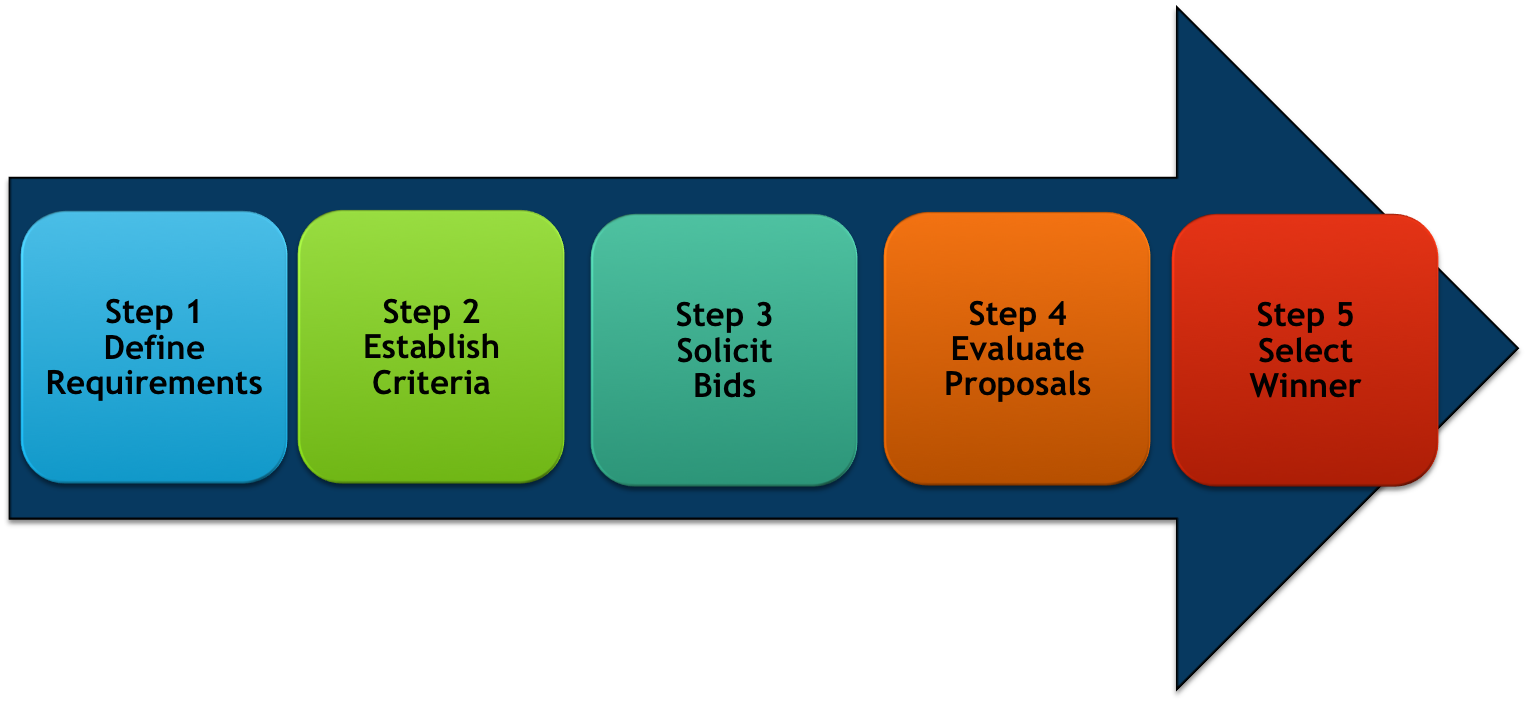
Step 1 – Define Requirements
Typically, organizations will refer to the initial phase of buying anything (whether a product or service) as procurement planning. Procurement planning is the process of deciding what, when, and how to purchase (buy) goods or services. This process involves the development of documentation to solicit (request) quotations, bids, and/or proposals from companies or individuals to complete a program, project, or task. Like any investment at the parish, whether large or small, getting clear on goals, needs, and requirements is critical.
Church Roof Replacement Example: Depending on whether the replacement of the roof is an immediate or longer-term need, the parish administrator and pastor discuss the timing for initiating the project. They discuss and decide that the work should be completed by November so that the roof is protected for the winter months. They also discuss the desire to work with a company that has previously worked with churches and comes highly recommended from a neighboring parish.
By brainstorming requirements, you establish some guideposts for the next step in the process. If you are unsure where to begin, many dioceses have resources available to help parishes in this phase of the process. There are also organizations that offer tools and templates to assist churches with defining requirements related to procurement decisions.
Step 2 – Establish and Weigh Criteria
Once requirements have been developed, it is important to brainstorm and establish criteria to evaluate potential contractors/vendors. Like the example of the teachers creating a rubric for essay evaluation, what are the driving factors that will help you make the decision on which contract/vendor to choose? To determine priority weights, consider the relative importance of each criterion and the impact this criterion should have on the overall score.
- Prioritize. Initially, you may have a large list of requirements and criteria. Take time to narrow the list down so that you have only the most critical items. Otherwise, you might fall into the trap of ‘information paralysis’ where it is difficult to differentiate any information.
- Ensure that you have clear criteria definitions. Definitions will ensure precision around what has been developed so that you can return to this information in the future. Have you ever attended a meeting, a decision is made, and then a month later everyone gets back together and forgets what was decided? If this sounds similar, you are not alone; it happens in every organization.
- Keep rating scales simple. Whether you decide to use a 1-100 (A+) or 1-10 (high) scale to rate proposals, simplicity will help reduce any confusion. You may also consider creating definitions for the scales. For example, “To receive a score of 10, the proposal must include X, Y, Z.”
- Collaborate! Use a team approach and get others involved in this process. No need to let all of the responsibility for this process fall on one person. Allow this process to be a shared responsibility.
Step 3 – Solicit Bids
Next, you are ready to seek contractors/vendors to bid on the work. The solicitation document that is commonly used to seek bids from service providers is called a Request for Proposal (RFP). The RFP will typically include answers to the following questions:
- What is the nature of the project? What are the requirements and expected deliverables for the work?
- Where is the location of the work? Who is the organization that is making the purchase?
- How will proposals be evaluated and what are the submission guidelines?
- When are proposals due?
- Who is the main point of contact?
In the Catholic Church, many dioceses will also have particular laws (financial policies) in place that require parishes to participate in specific bidding processes. For example, some dioceses require that for contracts over a specific dollar amount, the parish must request bids from at least three companies. It is imperative to be aware of what diocesan protocols may be required when examining these issues at the parochial level.
Step 4 – Evaluate Proposals
Once proposals have been requested and submitted, gather the team, and score the proposals using the criteria and weights that have been established. In choosing who should take part in the evaluation process, consider key people that will be most involved in working with the contractor/vendor.
Church Roof Replacement: Companies A, B, and C have submitted proposals for the roof replacement project. The pastor, along with the parish administrator and a member of the church maintenance staff reviews the proposals and score them against the established criteria. Once the ratings have been completed, the group will gather to discuss the results.
There are many ways to tabulate the results, but a straightforward approach is recommended. Recall the method used by the teachers to grade essays in the example above. The process can be simple:
- Individually grade the proposals (essays)
- Average the grades per proposal
- Summarize and discuss the results.
Step 5 – Select Winner
Bring the evaluation team together and discuss scoring results for each proposal. At this point, the hard work you have completed in earlier steps of the process will pay off. You have all of the information you need to make a great selection decision.
Church Roof Replacement: Company A and B came out with the highest scores. After reviewing the information, the team decided to go with Company B. Although the bidding price from Company B was slightly more expensive than Company A, the differentiating factor came down to Company B’s excellent references and their extensive work with churches.
In this step, be sure to allow raters to confer on why they chose certain ratings for the various proposals. Rating or metric based systems are only one means of evaluation. Subjective data from individual experiences, organizational history, and general knowledge of a topic should never be discounted. The key is to bring people together, recognize and openly discuss any biases and celebrate the fact that there are always differences of opinion. “No one of us is as smart as all of us.”
Summary
Create a process, even a simple one, to evaluate and select contractors/vendors for major purchases of products or services. By defining requirements, establishing criteria, and developing a simple, yet clear evaluation and selection process, many positive results occur. First, the process will promote a spirit of equity, openness, and accountability both internally for the parish management team and externally for those working with the church. Second, although every decision will not have the same requirements, by following this systematic approach, you will have created a strategy that you can transfer and repeat for future purchasing decisions. Finally, the results of this process promote a church management structure that is efficient, effective, and transparent in conducting the business of the church.
This article was originally published by Villanova University’s Center for Church Management and Business Ethics by Michael Castrilli