Church Management Academy

Education for Church Managers

  • Home Page
  • Education & Resources
    • Blog
    • Book
    • Workshops
  • About Us
    • Michael Castrilli
You are here: Home / Archives for Church Budget and Finance

By Michael Castrilli

Church Priorities + Budget = Results

picture of the outside of St. Paul Catholic Church in Philadelphia Pennsylvania

Show me your budget and I can tell you how you spend your time, where you focus your resources, and what you believe are the greatest priorities for your church and programs.

Think about your personal spending. If you showed me your latest bank statement or credit card bills, I would be able to tell you how you spend your time and where you focus your personal resources. All I would have to do is take your income and expenses for the statement period and assign categories to the ones we see repeated.

For example, I may see expenses for great restaurants (dining), a gym membership (fitness), doctor visits or medications (medical), and ticket purchases for shows and concerts (entertainment).

On the incoming side, I may see a check deposit from your job (salary). If you provided two or three months of data, I would have a good idea about how you prioritize resources.

Tip 6:  The budget is a reflection of your pastoral priorities

The same can be said of your church priorities. What are the categories of income and spending that the parish receives and spends? Most likely, the largest income category for the church includes offertory collections while staff salary and benefits drive the majority of expenses. These categories make sense as priorities. Without collection income, the church would have virtually no resources to operate besides savings or any endowments. Salary and benefits also make sense because of the need for the most critical resource for any organization—people to accomplish the work.

This makes analyzing the next categories of spending very important. After salary and benefits, what is the next highest level of spending? And next? And next? This is when budget analysis can really help determine a way forward (More on this topic later in the week).

There is no doubt that church leaders are busy people, so the next step in the process is to take the data that has been collected and focus your time. Focusing on the “right” areas of the budget means prioritizing your time so that you spend the greatest amount of effort in those areas that will provide the most significant benefits. A nice tool to deploy during this phase of the process is to calculate the Budget Category Impact Percentage (BCIP). Tomorrow, we will discuss how to calculate the BCIP!

Read More Church Finance 30/30 Tips

Filed Under: Church Budget and Finance Tagged With: Church Finance Tips

By Michael Castrilli

Limit Church Bank Accounts

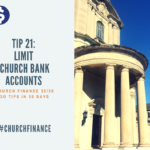
Tip 21, Limit church bank accounts and a picture of the chapel at St. Borromeo Seminary

It’s not unusual in a typical church for each ministry or organization to want control of their finances. Each will insist they need their own checking account. They don’t.

If a church has too many checking accounts it makes it difficult, if not impossible, for the church’s leadership to maintain control of finances. This will impact, not only the ability of the parish to provide accurate financial information but will greatly increase the opportunity and the temptation for embezzlement.

As my co-author Dr. Chuck Zech notes in our Parish Finance book,

In a classic case, when the Diocese of San Diego declared bankruptcy in 2007 in conjunction with the clergy sexual abuse scandal, it was discovered that the average church had eight checking accounts. The presiding judge wondered aloud how any parish could effectively control its finances with that many individual checking accounts. The authors have tales of parishes with more than 50 checking accounts, each controlled by a separate parish organization. This is clearly untenable

In reality, some church organizations do need their own checking account. A parochial school, for example, needs its own account. A national fraternal organization, like the Knights of Columbus, could justify having its own checking account. But the choir, adult education committee, youth group, etc. will also argue that they need their own separate checking account.

Limit Church Bank Accounts – One Checking Account Can Work!

The vast majority of church organizations could easily get by simply having individual line items in the parish’s statement of accounts, one for revenue and one for expenses. That would allow the parish to control the organization’s finances while still providing the opportunity to monitor its budget. By creating a budget that is built by program area, there is no need for separate accounts because managers can easily access reporting information.

Read More Church Finance 30/30 Tips

Picture of the front and steps of Saint Martin of Tours Chapel, St. Charles Seminary, Philadelphia, PA
Saint Martin of Tours Chapel, St. Charles Seminary, Philadelphia

Filed Under: Church Budget and Finance Tagged With: Church Finance Tips

By Michael Castrilli

Fraud Alert: 5 Tips to Protect Church Collections From Theft

Tip 19, Protect church collections from theft and a picture of the interior of St. Paul Outside the Walls, Rome, Italy

There is nothing worse than reading about a Church who has lost thousands or even millions of dollars due to theft. Unfortunately, church collections are very susceptible to fraud because the theft involves something that is difficult to track – cash!

It would never happen here, not at our Church! 

Our parishioners would never steal!

This is a Church — people are honest here!

Yes, I do believe that a majority of people are honest, but sin is a problem for a reason. I always like to say; most fraud doesn’t happen overnight. Fraud can occur slowly, even one dollar at a time and next thing you know – thousands, or in the case of some churches, millions are gone.

Fraud can occur as easy as:

Tom, the church usher, finds himself alone in the sacristy ready to put the Sunday collection in the safe. He pauses and thinks, “I work hard for this church as a volunteer. I’ve been here for 20 years; no one will care if I take a $10 bill, this church brings in tons of money.” The following week he takes a few $10s, and as time goes by, the dollars add up.

Jamie, the church administrator, always has the pastor review and sign the deposit slip before she leaves the bank. However, on her way, sometimes Jamie will make a second deposit slip that leaves out $50 or maybe $100 in cash. She forges the pastor’s signature (he won’t mind), and the bank does not notice. The fraud goes unnoticed because Jamie not only makes the deposits; she also reconciles the accounts in the church financial software.

Prevent Fraud – Protect People

Here is the main point – creating safeguards (aka internal controls) for assets is not about trust – internal controls are about protection and accountability.

Question: “Whoa – I’ve been here for years! You don’t trust me?”

Response: “This is not about trusting you, this is FOR YOUR PROTECTION.”

Think about it this way – without strong internal controls, if the money goes missing, how are people protected? If there is no process, there is also no protection. Without shared accountability, individuals are left in the lurch.

5 Tips to Safeguard Church Collections

Tip #1: Send Them Out Two-By-Two – Never allow one person to be alone with collections. If someone is bringing the collection to the office or the safe, have at least two people present.

Tip #2: Rotate Collection Counters – Set up a schedule for different people to count collections for different weeks. If people are in cahoots, and the same people count money in the same weeks, this can lead to fraud.

Tip #3: Create Checks and Balances (Literally) – Financial responsibilities should never rest on one person’s shoulders. The person who makes the bank deposits should not be the person who reconciles the accounts. An individual who writes the checks should not be the only one who signs the checks.

Tip #4: Communicate Proactively – An Information vacuum can cause people to create dirt. Establishing policies without proper communication lead people to suspicion and gossip – “Oh, I heard Laurie might be stealing money.” Be proactive with the answers to what, why, and how new policies are established.

Tip #5: Speak to Fears –  Respond with “This is for your protection,” when confronted with “You don’t trust me?” Changing financial policy is not about a lack of trust but about safeguarding assets and sharing accountability.

Questions? Comments? Contact me at ChurchManagementAcademy@gmail.com.

Read More Church Finance Tips 30/30

Filed Under: Church Budget and Finance Tagged With: Church Budget and Finance

By Michael Castrilli

Happy New Year 2024!

Thank you for your ongoing support of the Church Management Academy! We look forward to continuing to bring new content to our readers in 2024. If there is something you would like to read more about on these pages in 2024, let us know at ChurchManagementAcademy@gmail.com. May this year be blessed!

Filed Under: Church Budget and Finance

By Michael Castrilli

You Can’t Say Thank You Enough

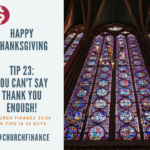
Happy Thanksgiving, Tip 23, you cant say thank you enough. The picture is of Sainte Chapelle Chapel in Paris

Happy Thanksgiving!

Thank you for being a follower of this blog, for your support, and for all that you do to make the Academy what it is today. Thanksgiving reminds me yet again reflect on how grateful I am for all of you.

In celebration of Thanksgiving, I have been thinking about the art of the thank you note!

I truly believe you can’t say thank you enough. Some people tell me they don’t agree. But I go back to what my mom taught me as a little boy. She would say, “When you offer thanks, it is letting people know that YOU care.”

No duty is more urgent than that of returning thanks. – St. Ambrose

For church donors, a thank you note is an acknowledgment of generosity of someone’s time, treasure, and talent – and in some cases, their love!  People have taken time to give, to offer, and to provide. We should let them know we appreciate what they’ve done. “Oh, no need to thank me.” But it is not about need or reciprocation, it is about an acknowledgement. You care enough to say thank you.

Do everything for the love of God and His glory without looking at the outcome of the undertaking. Work is judged, not by its result, but by its intention.
– Padre Pio of Pietrelcina

Don’t delay

I don’t know about you, but I have procrastinated at times writing thank you notes. Not because I don’t want to write a thank you note, but sometimes, in an effort for the note to be “perfect,” I wait until the perfect time to write. Instead, write the note promptly, get it done, it will be appreciated.

Be heartfelt

Tell a story, let people know how you feel about their gift or donation.

Be authentic

Write what is true for you. I don’t think you can mess up a thank you.

Practice

Like all things, practice makes perfect.

As many of you know, I have a deep love for St. Francis DeSales and his practical wisdom. I love this quote:

You learn to speak by speaking, to study by studying, to run by running, to work by working; and just so you learn to love God and man by loving. Begin as a mere apprentice and the very power of love will lead you on to become a master of the art. – St. Francis De Sales

I’d like to add to the quote, and I think St. Francis would agree wholeheartedly, to give thanks by thanking!

May your Thanksgiving be wonderful!

In gratitude,

Michael Castrilli

Here are some good blog posts about saying thank you to donors:

  • 5 Thank You Letters Donors will Love, Joanne Fritz
  • Delight Donors and Volunteers With Hand-Written Thank You Notes
  • Donor Thank-You Letters: 6 Actionable Tips

I would love to hear from you as to how you thank those who support your church,  your work, your ministry! Contact me!

Read More Church Finance Tips

The stained glass windows at Saint Chapelle Chapel in Paris
Saint Chapelle Chapel, Paris, France

Filed Under: Church Budget and Finance

  • « Previous Page
  • 1
  • …
  • 5
  • 6
  • 7
  • 8
  • 9
  • Next Page »

Sign-Up for Academy News and Resources

We promise not to spam you!
* indicates required


Copyright © 2026 Church Management Academy